
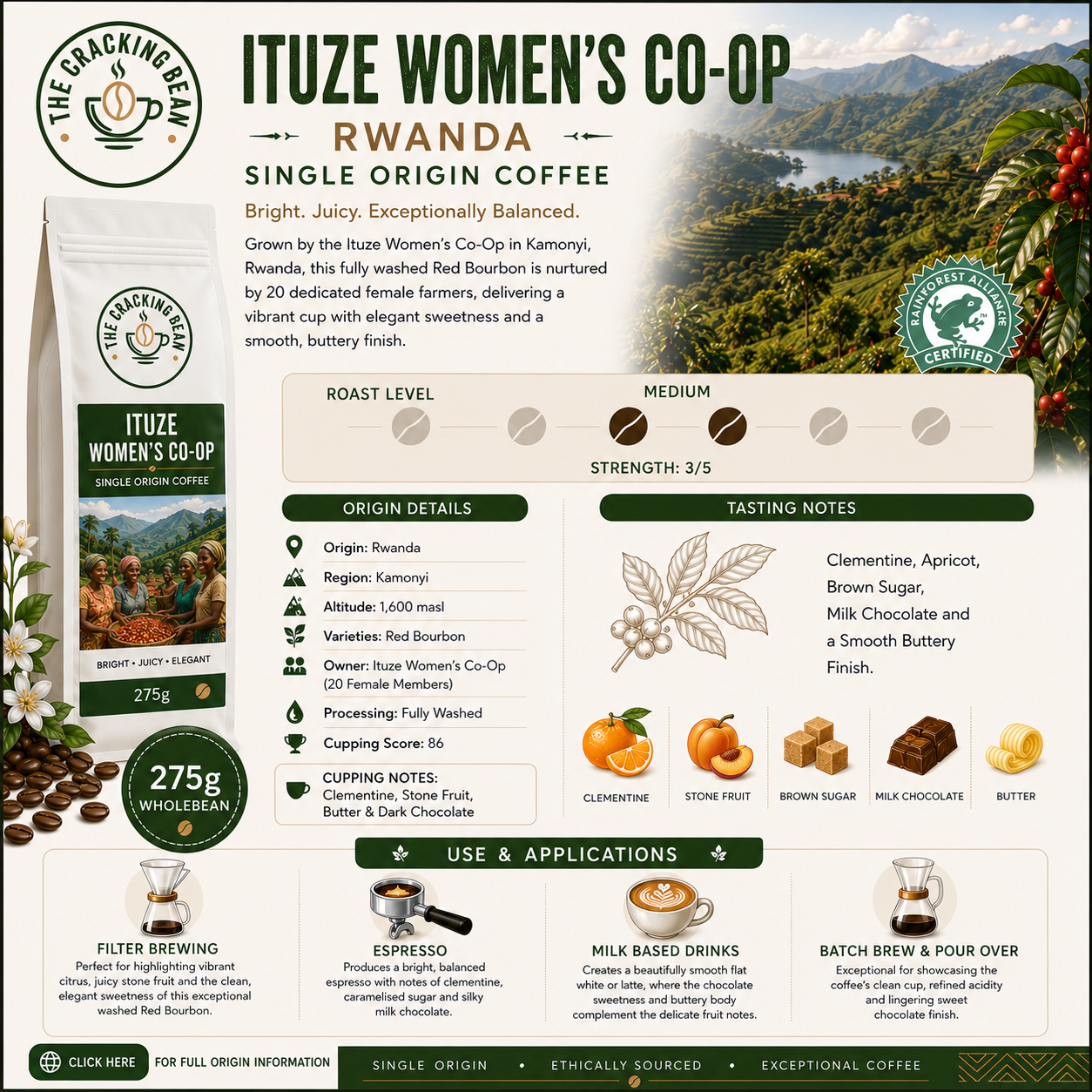
Rwanda Ituze Womens Co-Op
Medium Roast
In 2008, 18 women who were diagnosed with HIV/AIDS came together to form the Ituze Women Cooperative. They were facing many challenges, but they were determined to create a better future for themselves and their families.
In Kinyarwanda, “ituze” means “calmness”, which is the effect the women wanted their cooperative to have. The cooperative’s first goal was to provide support and friendship to its members. They met regularly to share their experiences, offer each other advice and simply lend a listening ear. This sense of community was essential to their success.
The cooperative also set out to generate additional income. They began by farming coffee and pineapples, and they soon realized that they had a knack for business. They were able to increase their yields and improve the quality of their products.
In 2018, the cooperative received a grant from the Kahawatu Foundation to purchase seedlings, shade trees and manure, which further boosted their productivity. They also received training in soap manufacturing, which has become a profitable new venture.
Today, the Ituze Women’s Cooperative is a thriving business. They have over 20 members, and their products are sold locally and in the capital city of Kigali. They have also been able to save an impressive amount of money through a Village Savings and Loan Association (VSLA). In their first year, they saved over $1,000, which was used by each member to pay for medical insurance, rehabilitate houses, buy educational materials and purchase livestock.
The members also produce homemade soap, which they sell for an additional source of income. They first learned soap making techniques in August 2021 when Kahawatu Foundation provided a training. Since then, they have been able to make a strong income from selling soap and have invested their income in additional businesses in a sustainable manner.
Cultivation
In addition to coffee, the group also grows 10,000 pineapples only a half hectare farm. They were able to rent the land for pineapple cultivation with proceeds from selling homemade soap and their coffee growing income. Kahawatu Foundation has supported their efforts by contributing 8 metric tons of composite manure to fertilizer the pineapple plot in March 2022.
Harvest & Post-Harvest
The women of Ituze selectively handpick ripe, red cherry and deliver it to Ngamba washing station. At intake, specially trained staff float cherry to remove underripes and then visually inspect cherry and remove any defects. Cherry is pulped and fermented for 10 to 12 hours in fermentation tanks. Following fermentation, parchment is washed in clean water and laid on raised beds to dry. Workers rake parchment frequently to ensure even drying and visually inspect parchment to remove any damaged beans. It takes approximately 21 to 30 days for parchment to dry.
RWACOF (Sucafina in Rwanda)
In concert with our sustainability partner, Kahawatu Foundation, RWACOF invests heavily in yield improvements, farmer training, quality improvement projects, environmental sustainability and other ways to increase farmer livelihoods.
RWACOF’s Farmer Development Program in partnership with the London School of Economics (LSE) supports farmers with training in Good Agricultural Practices and access to loans, farm inputs and farm services. A new soil health initiative uses soil analysis data that RWACOF collected to identify farms where soil is too acidic. Lime, along with education about application, is distributed to these farmers to help improve soil quality. Additionally, seedling nurseries provide up to 4 million seedlings per year to help farmers renovate their rootstock.
RWACOF also has many projects that are designed to support farmers’ overall livelihoods. They focus on gender equality and support several women’s cooperatives by helping them access land, seedlings and reach a market for their coffees. They offer trainings on financial literacy and alternative income-generating activities.
The Farmer Hub program built retail shops that buy other crops from farmers and sell them to families and schools at fair prices. These retail shops help promote income diversification by creating a market for other crops and they supply nutritious foods at competitive prices. The Farmer Hub program also offers loans to farmers as part of the farm management program.
On the environmental side, RWACOF has worked with partners to help install solar panels at 2 washing stations that are off the electrical grid. RWACOF’s dry mill already have a 50 kilowatt-per-hour solar panel set up on their roof. They’ve also mapped carbon emissions in their coffee supply chain and are starting projects to half their emissions per kg of coffee. Two ways they’re accomplishing this is by facilitating a transition from inorganic to organic fertilizer and further improve waste (water and pulp) management at the wet mills. They’re also working with Trade in Space to map deforestation in the supply chain so that they can begin to work with farmers to reduce deforestation and improve forested areas in the supply chain.
Above all, RWACOF’s exceptional attention to detail during post-harvest activities ensures the best quality coffee possible. From the moment cherry enters the washing station until it is milled and bagged for export, RWACOF keeps stringent quality controls in place. They know, as we do, that high-quality coffee is crucial for delivering benefit all along the supply chain.